| SPECIFICATIONS | |
| Denomination | 2 Stuivers |
| Alloy | Silver.583 |
| Type | Struck |
| Diameter | 23.5 mm |
| Thickness | 0.7 mm |
| Weight Legal | 1.73 gms |
| Weight | 1.38 gms |
| Shape | Round |
| Edge | Plain |
| Die-Axis | 240° |
| Mint | Holland |
|
|
| ||||||||||||||||||||||||
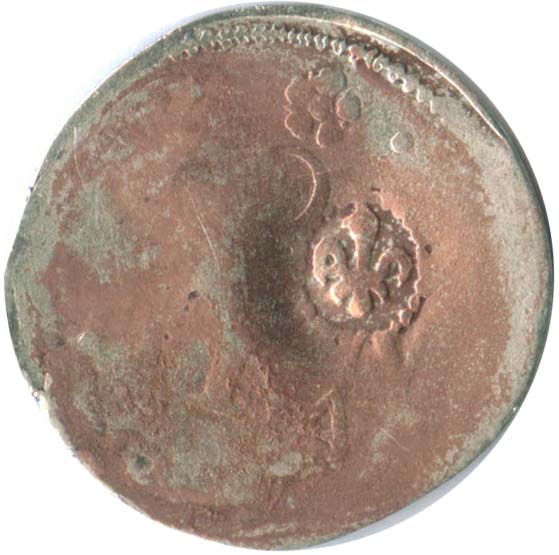
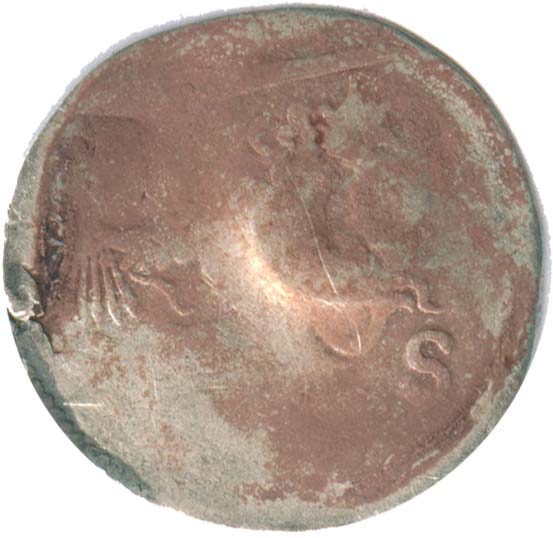
| c/m on Holland KM#27 | ||||||||||||||||||||||||||
A French countermarked dutch Double stuiver coin has not been previously reported as having been found in Lanka. Codrington lists Double stuiver coins from Gelderland, Holland, West Friesland, Zeeland, Urecht, Friesland, Overijssel, Deventer, Kanpen and Zwolle.
This 2 Stuiver is 20% under-weight which may be accounted for by ware during circulation and the probable light shaving of the edge often seen in coins of this Era.
A French fleet under the command of the lieutenant general of India, Jacob Blaquet de la Haye departed from the French port of Rochefort, on 29 March 1670, composed of 9 vessels with 2,250 men on board and 251 guns. At their arrival in the bay of Trincomalee on 22 March 1672 the French fleet represented an enormous naval power for the Indian Ocean. See history and article
Is this a random coincidence, or could this French coin have come with this French Fleet to Ceylon. The Year of the hoard matches exactly the Year of departure of the French fleet from Europe.
When I asked about the countermark Jan Lingen of Netherlands wrote:
It is a French countermark, period of Louis XIII (1610-1643).
Description: Oval countermark with a lily within in a
dotted border. The countermark was applied in France to declare
current a 1 sol or stuiver of 12 deniers for 15 deniers, against a
payment of 2 deniers.
Strangely enough such c/m's are found on double stuivers
of Holland, Zeeland en Overijssel and some other Dutch coins.
Contemporary records mention complains, that for the sake of profit,
also other than the accepted French coins were countermarked. This may
explain that they are sometimes found on certain Dutch coins.
Nevertheless it is surprising that a Dutch 2 Stuiver, countermarked in
France, founds its way to India and from there to Ceylon.
The c/m is on a 2 Stuiver of Holland.
I got this info verified by the utmost expert of
countermarks in the Netherlands and he fully agreed.
Ref.: Beranger, M., L'origine de la surfrappe d'une fleur de lis
apposee sur differentes monnaies anterieures a 1640, Revue
Numismatique 4.21 (1917-1918), Prochs Verbaux, seance 1918, page LXVIII.
If anyone has or have seen reported a french lily counter marked Dutch coin found in India please E-mail
The coin was cleaned lightly with with 15% Solution of citric Acid to expose detail. Removal of corrosion left a copper stain because of over 40% copper in composition.
Coin was scanned at 600dpi and displayed at 300dpi.
It was obtained in 2010 September from a Lankan Dealer as part of a
small hoard of silver (1600-1669) coins
which also included
9 Double Stuiver coins from
Zeeland and
7 Double Stuiver coins
Overijssel, a Roosschelling coin of Holland and a Portuguese Double Tanga GA-DS
coin.
The hoard is claimed to have been with a Lankan family for many generations.
This coin and hoard was announced in E-sylum 2010 Sept 19th which is a US based weekly electronic Newsletter on coins to which I contribute.
See fleur de lis countermark on a Silver douzain coin of Charles X of France (1589-1590) found in Cornwall UK.